If you’re dairy free, you’ve probably noticed that dairy is everywhere. It’s the creamer in your coffee, butter in every baked good, and cheese on everything. Pick up any odd item at the grocery store and “Contains: Milk” will likely be listed beneath the ingredients. Some days, it seems inescapable. But for every dairy staple you’ve left behind, there’s a substitute that holds its own. This guide breaks down the most common dairy free swaps, category by category, so you can stock your kitchen with confidence and never feel like you’re settling or risking your own health.
Plant Based Milks
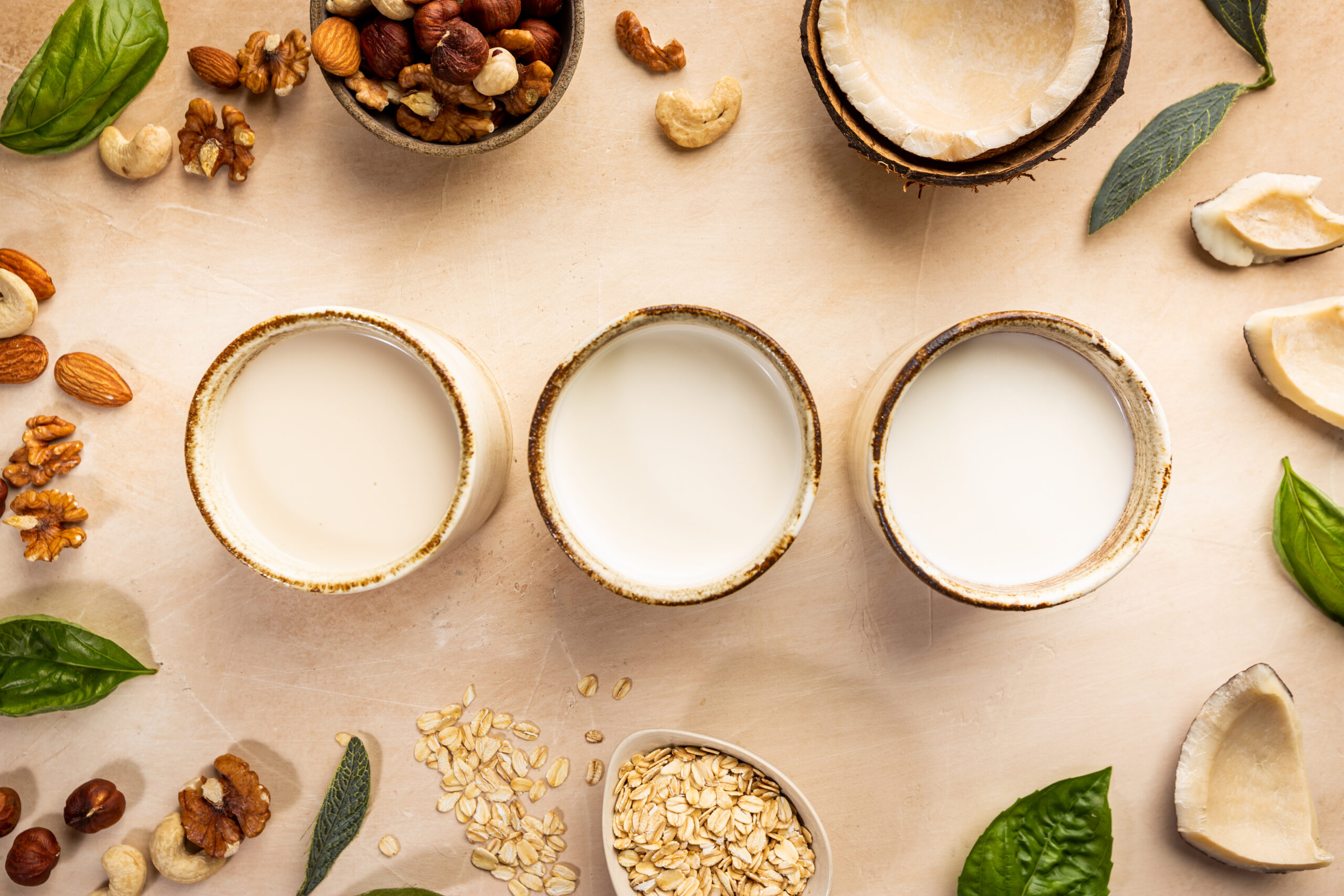
If there’s one category that has truly exploded in the dairy free world, it’s milk. Walk down the refrigerated aisle of any grocery store and you’ll find an entire wall of options. The audience for plant based milks has grown immensely, to the point where every coffee shop usually has at least two different options. This makes things both exciting and overwhelming, but the good news is that once you understand what each variety brings to the table, choosing the right one for you and your needs becomes easy.
Oat Milk
Oat Milk saw a huge boom in the late 2010s, and now it’s everywhere. It’s creamy, mildly sweet, and versatile enough to act as a pantry staple. It works in coffee, cereal, baking, and cooking. On top of that, there are many different flavors to choose from. Depending on if you prefer sweeter, creamier, or even lower calorie, you will be able to find one you like. There are also barista blends, which froth up into beautiful lattes. If you’re just getting started, oat milk is the safest first pick.
Almond Milk
Almond milk is a lighter choice that is also commonly available. Most coffee shops also carry this as an option; although it doesn’t froth as well as oat milk, it has a distinct, nutty taste that many people prefer. It’s great in smoothies, cereal, and pretty much anything one could use skim milk for. While it’s not always the best choice for baking, it also comes in a large variety of flavors and brands which make finding an almond milk you enjoy easy.
Soy Milk
When looking for a match in texture and protein content, soy milk is the closest you can get. It’s thicker, creamier, and another great option for a pantry staple. It does not have a distinct flavor in the way that oat milk or almond milk do, nor is it sweet. That is, unless you buy a sweeter brand, because there’s just as much variety in soy milks as almond and oat.
Coconut Milk
Coconut milk comes in two different forms: in a carton, or in a can. In a carton, it acts very similar to almond milk. But in a can, coconut milk has a very high fat content that makes it a unique and versatile replacement for butter, half and half, or heavy cream. It’s shelf stable, which makes it easy to keep on hand in your pantry for curries, soups, and even desserts. Most dairy free dessert replacements utilize this form of coconut milk to create a stable texture.
The bottom line is that there is no one-size-fits-all option for diary free milks. It depends a lot on what your daily diet looks like, as well as personal preferences. But if you’ve stepped in the dairy aisle of a grocery store within the past five years, you probably know that these aren’t the only options. View The Last Plant Based Milk Guide You’ll Need to explore every different type of currently available non dairy milk, including many less common types.
Dairy Free Yogurt
Yogurt made without dairy is not as straight forward as milks, nor with as wide of a range, but many brands have started quietly slipping non dairy options into their lineups. The most common kinds you will see are coconut milk yogurt, cashew yogurt, and almond milk yogurt, although other kinds do exist. For nutritional content, always read the label to see if it aligns with your needs, because it varies greatly between flavors and brands.
Many people enjoy eating yogurt due to its probiotics and high protein content. While a cashew yogurt likely won’t have the same cultures as a dairy yogurt, they will have their own. You can always check which cultures are included by examining the ingredients list on the package. For protein content, most plant based yogurts have a naturally lower protein content. However, some brands have developed alternatives with added pea protein to increase the protein content.
An important note is to always double check the ingredients. There are many brands that are labeled as coconut or almond, but still contain milk. Double check the allergens on the back to ensure that the yogurt is truly dairy free, and not just flavored.
Plant Based Butter
Here’s the good news about dairy free butter: it is one of the most seamless swaps you will make. Most plant based butters are a true one to one replacement for dairy butter, which means easy swaps in baking. Most major grocery stores will carry a vegan butter option, which is usually comprised of different oils and fats to create a dairy free butter that melts, spreads, bakes, and even tastes just like butter. It comes in both stick form and tub form, so you’re sure to find one that is compatible with your kitchen.
Other Butter Substitutes
If you’re not willing to try vegan butter, or maybe just don’t want one more thing crowding up your fridge, there are other options that you likely already have in your pantry that can be used as a substitute. Olive oil is a natural swap that works well in almost all baking recipes, with only a few exceptions. It also works just as well in cooking. Or, there’s also coconut oil, which has a higher smoke point than butter and most olive oils, making it great for high heat baking and cooking.
Dairy Free Cheese
Anyone who has tried it could tell you: cheese is the hardest swap. It’s the one that gets the most skepticism, and that’s because dairy free cheeses don’t work in quite the same way as cheeses with milk. Many grocery stores carry vegan cheeses, but if yours doesn’t or if there aren’t any options you’re happy with, it’s not impossible to create your own at home.
Cashew cheese is the most popular, both in flavor and in texture. It’s creamy, slightly tangy, and works great as a soft cheese substitute. It’s also the most approachable for homemade versions — soaked cashews blended with a few simple ingredients produce a surprisingly convincing result. The downside is that it does not melt as well as you may need.
For commercial options, shredded and sliced dairy free cheeses have improved significantly in recent years. They melt better than they used to and come in a wide range of varieties for easier swaps: mozzarella, cheddar, pepper jack, and more. They work well on pizza, in grilled cheese, on tacos, and anywhere else you’d reach for shredded dairy cheese. These are often comprised with a blend of soy and oils, and will melt easier than cashew cheeses, but don’t taste as rich as cheese.
Nutritional yeast is not a cheese replacement on its own, but it belongs in every dairy free kitchen. It has a naturally cheesy, nutty, savory flavor that adds depth to sauces, pasta, popcorn, and roasted vegetables. It’s necessary for making your own cashew cheese, or if you want to add it on top of vegetables. It may not be cheese, but it tastes close, is shelf stable, and easy to use.
Dairy Free Coffee Creamer
Just like milk, dairy free coffee creamer is thriving. Oat, coconut, and almond flavors are all popular, although oat milk is quickly becoming the leading choice. Oat milk creamer is different than standard oat milk; it’s thicker and pours with a consistency similar to half and half. That said, there’s dozens of options to chose from, so pick a flavor you love and try it!
The most dangerous thing to watch out for is “dairy free creamer” powder. Many coffee shops offer this as an option, and while some people who are dairy free can enjoy this, be very careful. It still contains caseinate of sodium, a milk protein that many have reactions to when consumed. You can think of it like lactose-free milk: for people who are lactose intolerant, it’s a great option, but being lactose intolerant and dairy free are not necessarily the same thing. It’s much better to stick to an option you know is safe for your body.
Whipped Cream and Cold Foam
While not as many options as coffee creamer or milk, there are many versions of whipped cream and cold foam that do not use milk. Many of these utilize coconut cream to keep them stable. You can also make your own at home easily: for whipped cream, refrigerate a can of full fat coconut milk overnight, scoop out the solidified cream, and whip it with a hand mixer until fluffy. For cold foam, simply froth barista blend oat milk with a handheld milk frother until thick and creamy.
The Tricky Part: Reading Ingredient Labels
Dairy hides under a surprising number of names on ingredient labels, and “dairy free” or “vegan” on the front of a package is helpful, but not always present or reliable. Reading the actual ingredient list is a vital habit to build when adapting to a dairy free lifestyle.
The obvious ones are easy to spot: milk, butter, cheese, cream, half and half, yogurt, and ghee. But there are many more ingredients that aren’t as straight forward, or sometimes even deceptive.
Some ingredients to watch out for:
- Casein and caseinate — milk proteins used in many processed foods, especially packaged snacks and granola bars.
- Whey — a milk byproduct found in protein bars, breads, and packaged snacks, especially ones with an emphasis on protein.
- Lactose and lactulose — derived milk sugars that show up often in processed, often sweeter treats.
- Dairy free creamer — perhaps the trickiest; created from milk-derived products, although lactose-free. Comes in a powdered form.
When reading labels, look for “Contains: Milk” or “May contain milk” beneath the ingredient list. The “may contain” designation indicates shared equipment or facilities, and is worth paying attention to. Depending on your sensitivity level, it’s important to have the full picture before consuming a new product.
The Bottom Line
With so many options available, choosing the right dairy free alternative comes down to your personal preference and what the intended usage is. Many ingredients are built around coconut, nuts, soy, or oats, and all have different uses depending on your goal. Educating yourself on all the possibilities, along with their advantages and disadvantages, will allow you to make a decision that best suits your needs.
Whether you are new to dairy free or have been living life without milk for years, the world and products available are evolving quickly. For recipe ideas or more comprehensible guides similar to this one, visit Saav Eats Dairy Free for your all-in-one stop for dairy free cooking.